We unleash your business potential by maximize the business innovation.
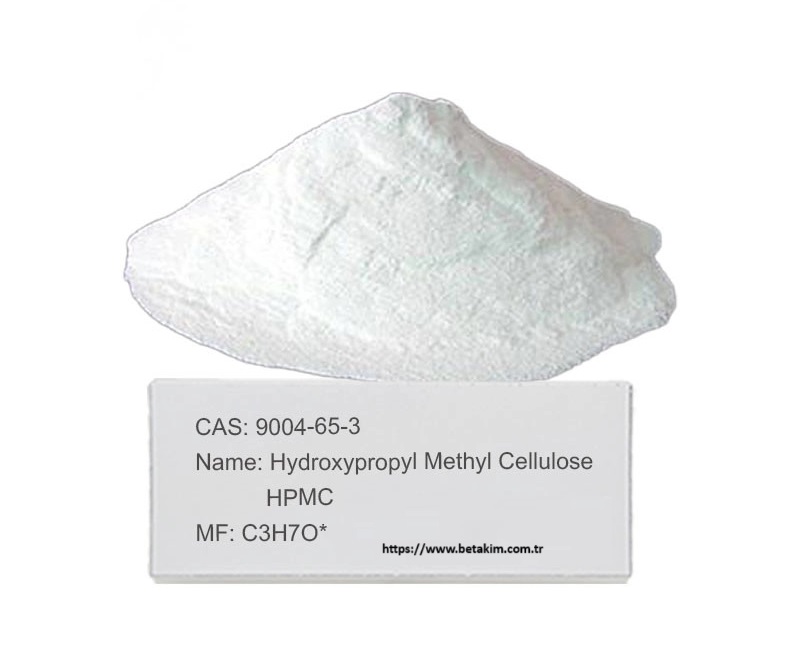
Send EmailHydroxy Propyl Methyl Cellulose, HydroxyPropylMethyl Cellulose, Hypromellose, HPMC, 9004-65-3
HPMC – Hydroxypropyl Methylcellulose:
CAS No: 9004-65-3
E Number (Food): E464
HPMC is a non-ionic, water-soluble polymer derived from cellulose. It is widely used in food, pharmaceutical, cosmetic, detergent, and construction industries. Its non-ionic nature ensures stability, water retention, and viscosity control.
Technical Specifications:
| Parameter | Value / Description |
|---|---|
| Chemical Name | Hydroxypropyl Methylcellulose |
| CAS No | 9004-65-3 |
| E Number | E464 |
| Appearance | White to off-white powder |
| Solubility | Soluble in cold water; insoluble in hot water |
| pH (1% solution) | 6.0 – 8.0 |
| Viscosity | 5 – 100,000 cps (depending on grade/application) |
| Thermogel Property | Forms gel at 50–55 °C |
Applications and Functions:
| Industry | Function / Application |
|---|---|
| Construction | Mortar stabilizer, water retention agent, binder |
| Food | Thickener, emulsifier, stabilizer |
| Pharmaceutical | Tablet coating, controlled release matrix |
| Cosmetics | Film former, viscosity enhancer, emulsion stabilizer |
| Detergents | Foam control, viscosity adjustment, surfactant support |
Production Process (Summary):
-
Cellulose is treated with alkali to obtain alkali cellulose.
-
Reaction with methyl chloride and propylene oxide produces HPMC.
-
The product is purified, dried, and milled into powder form.
-
Quality control tests include substitution degree, viscosity, and purity.
Physical and Chemical Properties:
-
Chemical Formula: Variable (cellulose derivative; not a fixed molecular formula).
-
Density: ~1.26 g/cm³
-
Decomposition Temperature: 225–230°C (no sharp melting point).
-
Solubility: Soluble in cold water; insoluble in ethanol and most organic solvents.
Sectoral Suitability Table & Typical Usage Levels for HPMC
| Industry | Function / Application | Typical Usage Level (% w/w) |
|---|---|---|
| Construction | Mortar stabilizer, water retention, binder | 0.1 – 0.5% (by weight of dry mix) |
| Food | Thickener, emulsifier, stabilizer | 0.1 – 0.8% (depending on product type; sauces, soups, dairy) |
| Pharmaceutical | Tablet coating, controlled release matrix | 2 – 5% (coating solutions); 5 – 35% (matrix formulations) |
| Cosmetics | Film former, viscosity enhancer, emulsion stabilizer | 0.2 – 2% (lotions, gels, creams) |
| Detergents | Foam control, viscosity adjustment, surfactant support | 0.1 – 0.5% (liquid detergents, cleaners) |
Notes:
-
Construction: Low dosages are sufficient to improve workability and water retention in cementitious systems.
-
Food: Regulatory limits apply (E464), typically below 1% depending on product category.
-
Pharma: Usage varies widely; in controlled release tablets, HPMC can be a major excipient.
-
Cosmetics: Concentration depends on desired viscosity and film-forming properties.
-
Detergents:Used in small amounts to adjust rheology and foam stability.
Other English Names
-
Hypromellose
-
Hydroxypropyl methyl cellulose
-
Methocel (trade name)
-
MHPC
-
Cellulose ether HPMC
-
Hydroxylpropylmethylcellulose
-
(Hydroxypropyl) Methyl Cellulose
General Information
-
Appearance: White or off-white powder
-
Solubility: Soluble in water, forming clear or slightly hazy solutions
-
Applications:
-
Pharmaceutical industry (tablet coating, binder, controlled release agent)
-
Food industry (thickener, stabilizer)
-
Construction (cement and mortar additive)
-
Cosmetics (gel and cream thickener)
-
Sectoral Suitability & Usage Levels
| Sector / Application | HPMC | HEMC | HEC |
|---|---|---|---|
| Construction (mortars, tile adhesives, plasters) | ✅ Highly suitable – water retention, workability, extended open time | ✅ Highly suitable – slip resistance, sag control | ⚠️ Limited – not ideal for cementitious systems |
| Typical dosage | 0.2–0.7% of dry mix weight | 0.2–0.7% | Rarely used (<0.1%) |
| Pharmaceuticals (tablets, coatings, capsules) | ✅ Widely used – binder, film former, controlled release | ⚠️ Rare – limited use | ⚠️ Rare – limited use |
| Typical dosage | 2–5% in tablet formulations | ||
| Food industry (thickener, stabilizer) | ✅ Approved – emulsifier, stabilizer | ⚠️ Limited | ⚠️ Limited |
| Typical dosage | 0.1–0.5% | ||
| Cosmetics & personal care (lotions, shampoos, toothpaste) | ✅ Viscosity control, smooth texture | ✅ Foam stability, viscosity | ✅ Thickener, stabilizer |
| Typical dosage | 0.3–1% | 0.3–1% | 0.3–1% |
| Paints & coatings (latex paints, emulsions) | ⚠️ Moderate – secondary thickener | ✅ Rheology control | ✅ Primary thickener |
| Typical dosage | 0.2–0.5% | 0.2–0.5% | 0.3–1% |
| Oilfield drilling fluids | ⚠️ Rare | ⚠️ Rare | ✅ Thickener, fluid-loss reducer |
| Typical dosage | 0.3–0.8% | ||
| Textiles & paper | ⚠️ Limited | ⚠️ Limited | ✅ Rheology modifier, binder |
| Typical dosage | 0.3–0.7% |
Key Insights
-
HPMC & HEMC dominate construction: Both are indispensable in cement-based mortars and adhesives.
-
HEC dominates paints & coatings: It is the primary thickener in latex paints, while HPMC/HEMC play secondary roles.
-
Pharma & food rely on HPMC: Regulatory approvals and functional versatility make HPMC the standard.
-
Cosmetics use all three: Choice depends on desired rheology and foam stability.
-
HEC is unique in oilfield & paper: Its salt tolerance and film-forming ability make it suitable.
How HPMC is Used in Construction
-
Mortars (cement-based):
-
Improves water retention, preventing early water loss.
-
Enhances workability and consistency.
-
Reduces cracking risk and ensures uniform curing.
-
-
Tile Adhesives:
-
Increases slip resistance.
-
Extends open time, giving workers more flexibility.
-
Improves adhesion strength and flexibility.
-
-
Plasters:
-
Provides better adhesion to substrates.
-
Controls flow and spreadability during application.
-
Balances drying time, resulting in a smooth surface finish.
-
Suitability and Benefits
-
Compatibility: Works well with cement, gypsum, and lime-based systems.
-
Advantages:
-
Excellent water retention, especially valuable in hot/dry climates.
-
Thickening effect ensures homogeneous mixtures.
-
Extends working time, reducing application errors.
-
Typical Dosage Levels
| Application Area | Typical HPMC Dosage (% by weight) | Main Effect |
|---|---|---|
| Cement-based mortars | 0.2 – 0.6 | Water retention, workability |
| Tile adhesives | 0.3 – 0.8 | Slip resistance, open time |
| Plasters | 0.4 – 1.0 | Spreadability, smooth finish |
Note: Exact dosage depends on cement/gypsum type, aggregate properties, and project conditions. Formulation optimization is essential.
Key Considerations
-
Overdosage → Excessive viscosity, reduced workability.
-
Underdosage → Poor water retention, higher cracking risk.
-
Cost factor → Higher performance but increased material cost; balance is crucial.
Suitability in Pharmaceuticals
-
Safety & Compliance: Non-toxic, biocompatible, widely accepted in pharmacopeias (USP, EP, JP).
-
Applications:
-
Tablet coating: Protects against moisture, oxygen, masks taste/odor, improves appearance.
-
Capsules: Used as a vegetarian/vegan alternative to gelatin in hard capsules.
-
Controlled release systems: Provides sustained or delayed drug release.
-
-
Advantages: Stable, versatile, compatible with many active pharmaceutical ingredients (APIs).
Usage Forms
-
Film coating solution:
-
Dissolved in water or hydro-alcoholic mixtures.
-
Sprayed onto tablets, followed by drying.
-
-
Capsule shells:
-
100% HPMC used to form hard capsule shells.
-
Resistant to humidity compared to gelatin.
-
-
Matrix tablets:
-
Incorporated into the tablet core as binder or release modifier.
-
Different viscosity grades selected depending on desired release profile.
-
Typical Concentrations
| Application | Approximate Concentration | Notes |
|---|---|---|
| Film coating solution | 2–10% | Adjusted for viscosity and sprayability |
| Sustained release tablet | 10–40% | Higher levels slow drug release |
| Capsule shell | 100% (gelatin substitute) | Used for vegetarian capsules |
Key Considerations
-
Viscosity grades: HPMC is available in multiple viscosity grades (e.g., 5 cps, 15 cps, 50 cps, 100 cps). Choice depends on application:
-
Low viscosity (5–15 cps): Ideal for film coating.
-
Medium viscosity (50–100 cps): Suitable for sustained release matrices.
-
High viscosity (>4000 cps): Used for strong gel-forming controlled release systems.
-
-
Documentation: Batch-specific COA and viscosity grade must be clearly stated for regulatory compliance.
-
Regulatory acceptance: Approved as excipient in major pharmacopeias.
Suitability in Food
-
Regulatory status: Approved as a food additive (E464) by Codex Alimentarius, EFSA, FDA, and Turkish Food Codex.
-
Safety: Non-toxic, non-digestible, considered safe for human consumption.
-
Functional roles:
-
Thickener (in sauces, dressings, dairy alternatives).
-
Stabilizer (in emulsions, foams, beverages).
-
Film former (used in edible coatings, bakery glazes).
-
Fat replacer (in low-fat formulations, improves mouthfeel).
-
Gluten replacement (in gluten-free bakery products, improves dough elasticity).
-
Usage Forms
-
Powder form: Dispersed in cold or warm water to form a viscous solution.
-
Solution/gel: Used directly in food formulations for texture modification.
-
Edible coatings: Applied as thin films on fruits, confectionery, or bakery products to reduce moisture loss and improve shelf life.
Typical Concentrations
| Application | Approximate Usage Level | Notes |
|---|---|---|
| Sauces, dressings | 0.1 – 0.5% | Provides viscosity and stability |
| Dairy alternatives (soy, oat) | 0.2 – 0.8% | Improves creaminess and mouthfeel |
| Bakery (gluten-free bread) | 1 – 3% | Enhances dough structure and elasticity |
| Edible coatings | 1 – 2% | Film-forming, moisture barrier |
| Fat replacer in low-fat foods | 0.5 – 2% | Mimics fat texture |
Key Considerations
-
Hydration: HPMC must be dispersed gradually in water to avoid lumping; high-shear mixing is often used.
-
Viscosity grades: Different grades (low, medium, high viscosity) are selected depending on desired texture.
-
Thermal gelation: HPMC solutions gel upon heating and liquefy upon cooling — useful in bakery and processed foods.
-
Stability: Resistant to enzymatic degradation, stable across pH ranges, and compatible with other hydrocolloids.
-
Documentation: Food-grade COA must specify viscosity grade, purity, and compliance with E-number regulations.
Supported Information
-
Codex Alimentarius & EFSA: Lists HPMC (E464) as permitted food additive with no specific ADI (Acceptable Daily Intake) due to low toxicity.
-
FDA (GRAS status): Recognized as safe for use in food.
-
Turkish Food Codex: Included under stabilizers and thickeners, permitted in bakery, dairy alternatives, sauces, and coatings.
Overview of HPMC (Hydroxypropyl Methylcellulose) in cosmetics & personal care :
Suitability:
-
Regulatory status: Approved for use in cosmetics and personal care; listed in INCI as Hydroxypropyl Methylcellulose.
-
Safety: Non-toxic, non-irritating, widely recognized as safe for topical and oral care applications.
-
Functions:
-
Thickener / viscosity modifier (lotions, shampoos, toothpastes).
-
Stabilizer (emulsions, suspensions).
-
Film former (moisture barrier on skin, protective layer on hair).
-
Binder (keeps toothpaste particles together).
-
Usage Forms
-
Lotions & creams:
-
Dissolved in the aqueous phase to provide viscosity and stability.
-
Leaves a soft film on skin, improving moisturization.
-
-
Shampoos & hair care:
-
Enhances foam stability and flow properties.
-
Forms a thin film on hair, improving softness and shine.
-
-
Toothpaste:
-
Acts as a binder for abrasives and other solids.
-
Prevents drying, ensures smooth texture.
-
Typical Concentrations
| Product Type | Approximate Usage Level | Notes |
|---|---|---|
| Lotions / creams | 0.2 – 1.0% | Provides light viscosity and moisture barrier |
| Shampoos | 0.3 – 1.5% | Improves foam stability and flow control |
| Toothpaste | 0.5 – 2.0% | Binder and thickener |
Key Considerations
-
Dissolution: Add gradually to water under high shear mixing to avoid clumping.
-
Viscosity grades:
-
Low viscosity (5–15 cps): best for shampoos and liquid products.
-
Medium viscosity (50–100 cps): suitable for lotions and creams.
-
High viscosity (>400 cps): ideal for toothpaste and gels.
-
-
Stability: Stable across pH 3–11, compatible with ionic surfactants and other cosmetic ingredients.
-
Documentation: Cosmetic-grade COA should specify viscosity grade, purity, and compliance.
Supported Information
-
INCI listing: Hydroxypropyl Methylcellulose.
-
FDA & EU Cosmetics Regulation: Approved for use in personal care products.
-
Practical advantage: More stable than natural gums, resistant to microbial spoilage, consistent performance.
Overview of HPMC (Hydroxypropyl Methylcellulose) in Paints & Coatings (Latex Paints, Emulsions) :
Suitability
-
Industrial acceptance: HPMC is widely used in water-based paints and coatings as a rheology modifier and stabilizer.
-
Functions:
-
Thickener (controls viscosity).
-
Stabilizer (keeps pigments and fillers uniformly dispersed).
-
Water retention agent (improves film formation, reduces cracking).
-
Rheology control (optimizes flow and leveling for brush, roller, or spray applications).
-
Usage Forms
-
Latex paints:
-
HPMC powder is slowly added to water under high-shear mixing to dissolve.
-
Incorporated into the paint formulation to adjust viscosity and application properties.
-
-
Emulsion coatings:
-
Enhances stability, prevents pigment settling.
-
Provides smooth film formation and surface finish.
-
-
Coating solutions:
-
Improves water retention, balances drying time, and reduces surface defects.
-
Typical Concentrations
| Application | Approximate Usage Level | Notes |
|---|---|---|
| Latex paints | 0.2 – 0.5% | Viscosity control, ease of application |
| Emulsion coatings | 0.3 – 1.0% | Stability and film formation |
| Water retention additive | 0.1 – 0.3% | Prevents cracking, ensures smooth surface |
Key Considerations
-
Dissolution: Must be added gradually to water to avoid clumping.
-
Viscosity grades:
-
Low viscosity (5–15 cps): suitable for spray applications.
-
Medium viscosity (50–100 cps): preferred for brush and roller paints.
-
High viscosity (>400 cps): used in thick film coatings.
-
-
Compatibility: Works well with pigments, fillers, and binders.
-
Documentation: Industrial-grade COA should specify viscosity grade, purity, and coating compatibility.
Supported Information
-
Industrial standards: HPMC is one of the most common cellulose derivatives in water-based paints.
-
Advantages: More stable than natural gums, resistant to microbial degradation.
-
Performance: Improves application properties, flow, leveling, and film integrity.
HPMC (Hydroxypropyl Methylcellulose) – Applications in Oil Drilling Fluids & Textile/Paper Industry:
Suitability
-
Oil drilling fluids:
-
Widely used as a viscosity modifier, fluid-loss reducer, and stabilizer.
-
Provides rheological control, improves suspension of solids, and reduces water loss into formations.
-
Compatible with both freshwater and brine-based drilling systems.
-
-
Textile & paper industry:
-
Functions as a thickener, binder, film-former, and sizing agent.
-
Improves printability, surface smoothness, and mechanical strength.
-
Used in textile printing pastes, warp sizing, and paper coatings.
-
Usage Forms
-
Oil drilling fluids:
-
Added as powder or pre-dissolved solution into the mud system.
-
Hydrates to form a viscous solution, controlling fluid rheology.
-
Reduces filtrate loss by forming a thin, impermeable filter cake on borehole walls.
-
-
Textile printing & finishing:
-
Mixed into printing pastes to control viscosity and prevent bleeding of dyes.
-
Used in warp sizing to improve yarn strength and reduce breakage.
-
Applied in paper coatings to enhance smoothness, gloss, and ink absorption.
-
Typical Concentrations
| Application | Approximate Usage Level | Notes |
|---|---|---|
| Oil drilling fluids | 0.2 – 1.0% | Adjusted for mud viscosity and fluid-loss control |
| Textile printing pastes | 0.5 – 3.0% | Controls dye penetration and print sharpness |
| Warp sizing (textiles) | 0.5 – 2.0% | Improves yarn strength and reduces hairiness |
| Paper coatings | 0.3 – 1.0% | Enhances surface finish and printability |
Practical & Sensitive Points
-
Hydration: Must be dispersed slowly in water under strong agitation to avoid lumping.
-
Viscosity grades:
-
Low viscosity (5–15 cps): preferred in drilling fluids for easy pumping.
-
Medium viscosity (50–100 cps): textile printing pastes.
-
High viscosity (>400 cps): paper coatings requiring strong film formation.
-
-
Compatibility: Stable across wide pH ranges; resistant to microbial degradation compared to natural gums.
-
Documentation: Industrial COA must specify viscosity grade, purity, and compliance with oilfield or textile standards.
-
Critical in drilling: Excessive dosage may increase mud viscosity too much, leading to poor pumpability.
-
Critical in textiles/paper: Overuse can cause excessive film thickness, affecting flexibility and print quality.
Supported Information
-
Oilfield standards: HPMC is recognized as a fluid-loss additive in API drilling fluid formulations.
-
Textile & paper industry: Commonly used as a safer alternative to natural gums (e.g., guar, starch) due to better microbial stability.
-
Performance advantage: Provides consistent viscosity, film strength, and stability across applications.