Cyclohexylamine, Cyclohexanamine, Cyclo Hexyl Amine, Aminocyclohexane, Hexahydroaniline, CHA, CAS 108-91-8
CYCLOHEXYLAMINE (CHA)
CAS Number: 108-91-8
EC Number (EINECS): 203-629-0
Molecular Formula: C₆H₁₃N
Molecular Weight: 99.17 g/mol
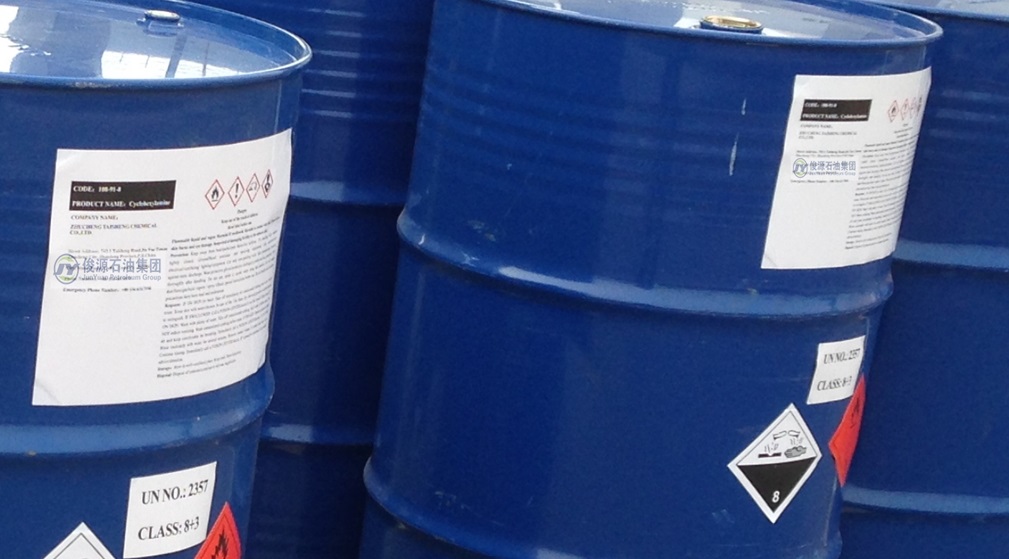
UN Number: 2357
SECTION 1: PRODUCT IDENTIFICATION AND CHEMICAL IDENTITY
| Parameter |
Description |
| Chemical Name (IUPAC) |
Cyclohexanamine |
| Other Names |
Cyclohexylamine, Cyclo Hexyl Amine, Aminocyclohexane, Hexahydroaniline, Cyclohexanamine, CHA |
| CAS Number |
108-91-8 |
| EC Number (EINECS) |
203-629-0 |
| Molecular Formula |
C₆H₁₃N |
| Molecular Weight |
99.17 g/mol |
| Chemical Class |
Aliphatic amine (primary amine) |
| Structure |
Cyclohexane ring with primary amine group (-NH₂) |
| Appearance |
Colorless to slightly yellowish liquid |
| Odor |
Pungent, fish-like amine odor |
| UN Number |
2357 |
| Hazard Class |
8 (Corrosive) + 3 (Flammable Liquid) |
| Packing Group |
II |
SECTION 2: PHYSICAL AND CHEMICAL PROPERTIES
| Property |
Value / Range |
| Molecular Formula |
C₆H₁₃N |
| Molecular Weight |
99.17 g/mol |
| Appearance |
Colorless to slightly yellowish liquid |
| Odor |
Pungent, fish-like amine odor |
| Melting Point |
−17.7°C |
| Boiling Point |
~134.5°C |
| Density (25°C) |
~0.865 g/cm³ |
| Refractive Index (n²⁰D) |
1.458 - 1.460 |
| Flash Point |
~32°C (closed cup) |
| Autoignition Temperature |
~294°C |
| Vapor Pressure (20°C) |
~12 mmHg (1.6 kPa) |
| Solubility in Water |
Miscible (~100 g/L @ 20°C) |
| Solubility in Organic Solvents |
Miscible with alcohols, ethers, ketones, aromatics, aliphatics |
| pH (1% aqueous) |
~11.5 (basic) |
| pKa |
~10.64 (weak base) |
| Explosion Limits |
1.5% - 9.4% (v/v) |
| Viscosity (25°C) |
~2.3 cP |
| Dielectric Constant (25°C) |
~5.0 |
| Vapor Density (air=1) |
3.4 (heavier than air) |
| LogP (octanol/water) |
1.49 |
SECTION 3: SOLUBILITY PROFILE
| Solvent |
Solubility |
Condition |
| Water |
Miscible (~100 g/L) |
20°C |
| Methanol |
Completely miscible |
- |
| Ethanol |
Completely miscible |
- |
| Acetone |
Completely miscible |
- |
| Toluene |
Completely miscible |
- |
| Xylene |
Completely miscible |
- |
| Ethyl Acetate |
Completely miscible |
- |
| Chloroform |
Completely miscible |
- |
| Hexane |
Completely miscible |
- |
| Ether |
Completely miscible |
- |
Critical Note: Cyclohexylamine is miscible with water and most organic solvents. Its weak basic character (pKa 10.64) and amphiphilic structure make it suitable for various applications.
SECTION 4: CHEMICAL PROPERTIES AND REACTIONS
| Property |
Description |
| Chemical Class |
Aliphatic amine (primary amine) |
| Functional Group |
Primary amine (-NH₂) |
| Basicity |
Weak base (pKa 10.64) |
| Reactivity |
High; exhibits typical amine reactions |
| With Acids |
Forms salts (e.g., HCl → cyclohexylamine hydrochloride) |
| With Acid Chlorides |
Used for amide synthesis |
| Alkylation |
Used in production of specialty amine derivatives |
| With Carbonyls |
Forms Schiff bases |
| With Carbon Disulfide |
Used in sulfenamide accelerator production (CBS, DCBS) |
| Thermal Decomposition |
> 250°C releases nitrogen oxides (NOₓ), CO, CO₂ |
| Oxidation |
Slow oxidation in air |
4.1. Key Reactions
| Reaction Type |
Description |
| Acid Salt Formation |
With HCl → Cyclohexylamine hydrochloride |
| Amide Synthesis |
With acid chlorides → Cyclohexylamide derivatives |
| Schiff Base Formation |
With aldehydes/ketones → Imines |
| Sulfenamide Synthesis |
With carbon disulfide → CBS, DCBS accelerators |
| Carbamate Formation |
Reacts with CO₂ |
| Alkylation |
Production of specialty amine derivatives |
4.2. Stability
| Parameter |
Information |
| Thermal Stability |
Stable under normal conditions |
| Oxidation |
Slow oxidation in air (color darkening) |
| Carbamate Formation |
Forms carbamate with CO₂ |
| Incompatibilities |
Strong oxidizers, acids (exothermic), acid chlorides, carbon disulfide |
| Decomposition Products |
Nitrogen oxides (NOₓ), CO, CO₂, ammonia |
SECTION 5: SPECTRAL DATA
| Parameter |
Value |
| FTIR (KBr, cm⁻¹) |
3350 (N-H), 3250 (N-H), 2950 (C-H), 2850 (C-H), 1600 (N-H bend), 1450 (C-H), 1120 (C-N) |
| ¹H-NMR (CDCl₃, ppm) |
2.75 (m, 1H, CH-NH₂), 1.85 (m, 2H, CH₂), 1.70 (m, 2H, CH₂), 1.60 (m, 1H, CH₂), 1.40 (s, 2H, NH₂), 1.20 (m, 4H, CH₂) |
| ¹³C-NMR (CDCl₃, ppm) |
50.0 (CH-NH₂), 35.0 (CH₂), 26.0 (CH₂), 25.0 (CH₂) |
| Mass Spectrometry (EI-MS) |
99 [M]⁺, 84 [M-CH₃]⁺, 56 [C₄H₈]⁺, 41 [C₃H₅]⁺ |
SECTION 6: PURITY AND QUALITY SPECIFICATIONS
| Parameter |
Standard Grade |
High Purity Grade |
| Purity (GC) |
≥ 98.0% |
≥ 99.0% |
| Appearance |
Colorless to slightly yellowish liquid |
Colorless liquid |
| Color (APHA) |
≤ 20 |
≤ 10 |
| Density (20°C) |
0.864 - 0.868 g/cm³ |
0.865 - 0.867 g/cm³ |
| Refractive Index (n²⁰D) |
1.458 - 1.460 |
1.459 - 1.460 |
| Water Content (KF) |
≤ 0.5% |
≤ 0.2% |
| Aniline Content |
≤ 0.5% |
≤ 0.1% |
| Acid Value |
≤ 0.5 mg KOH/g |
≤ 0.2 mg KOH/g |
| Ash Content |
≤ 0.1% |
≤ 0.05% |
| Color (Hazen) |
≤ 20 |
≤ 10 |
SECTION 7: MAJOR APPLICATIONS AND END-USES
7.1. Rubber Industry (Primary Application)
| Application |
Function |
Suitability |
| Sulfenamide Accelerators |
Key raw material for CBS (N-cyclohexyl-2-benzothiazole sulfenamide) production |
High |
| DCBS Production |
N,N-dicyclohexyl-2-benzothiazole sulfenamide production |
High |
| Vulcanization Systems |
Delayed-action accelerators in sulfur vulcanization |
High |
7.2. Corrosion Inhibitor
| Application |
Function |
Suitability |
| Boiler Systems |
Corrosion inhibitor in steam boilers |
High |
| Cooling Systems |
Corrosion inhibitor on metal surfaces |
High |
| Steam Lines |
Neutralizing amine |
High |
7.3. Sweetener Production
| Application |
Function |
Suitability |
| Sodium Cyclamate |
Raw material for artificial sweetener production |
High |
| Cyclamate Acid |
As intermediate |
High |
7.4. Pharmaceutical Industry
| Application |
Function |
Suitability |
| Mucolytics |
As intermediate |
High |
| Analgesics |
As intermediate |
High |
| Pharmaceutical Intermediates |
Various API syntheses |
High |
7.5. Agricultural Chemicals
| Application |
Function |
Suitability |
| Herbicide Production |
Hexazinone and other herbicide production |
High |
| Pesticide Formulations |
As intermediate |
High |
7.6. Solvent Systems
| Application |
Function |
Suitability |
| Specialty Solvent Mixtures |
As component |
Moderate |
| Extraction |
Selective solvent |
Moderate |
SECTION 8: INDUSTRY SUITABILITY MATRIX
| Industry |
Suitability |
Explanation |
| Rubber Industry |
High |
CBS, DCBS sulfenamide accelerator production |
| Corrosion Inhibitor |
High |
Boiler systems and metal surfaces inhibitor |
| Sweetener Production |
High |
Sodium cyclamate raw material |
| Pharmaceuticals |
High |
Mucolytic, analgesic synthesis |
| Agricultural Chemicals |
High |
Hexazinone herbicide production |
| Solvent Systems |
Moderate |
Component in specialty solvent mixtures |
| Cosmetics |
Not suitable |
Not approved for cosmetic use |
| Food |
Not suitable |
Not used as direct food additive (only sweetener intermediate) |
SECTION 9: TYPICAL USE LEVELS
| Application |
Typical Use Level |
| Rubber |
0.5% - 2% (in accelerator systems) |
| Corrosion Inhibitor |
ppm levels (based on system volume) |
| Sweetener Production |
Stoichiometric ratios with sulfamic acid |
| Sulfenamide Production |
Stoichiometric ratios with MBT |
| Pharmaceutical Synthesis |
5% - 20% of reaction volume |
SECTION 10: OTHER NAMES AND IDENTIFIERS
| Type |
Name / Description |
| IUPAC Name |
Cyclohexanamine |
| Commercial Names |
Cyclohexylamine, CHA |
| Synonyms |
Aminocyclohexane, Hexahydroaniline, Cyclohexanamine |
| Common Names |
Boiler protective amine, Sweetener raw material, Rubber accelerator base |
| CAS Number |
108-91-8 |
| EC Number |
203-629-0 |
| UN Number |
2357 |
| RTECS Number |
GX0700000 |
SECTION 11: PRODUCTION METHODS
11.1. Main Production Methods
| Method |
Description |
| Aniline Hydrogenation |
Aniline + 3 H₂ → Cyclohexylamine (nickel or cobalt catalyst) |
| Cyclohexanol Amination |
Cyclohexanol + Ammonia → Cyclohexylamine (high temperature and pressure) |
11.2. Reaction Details
| Method |
Reaction |
Catalyst |
Conditions |
| Aniline Hydrogenation |
C₆H₅NH₂ + 3H₂ → C₆H₁₁NH₂ |
Ni/Co |
High pressure, 150-200°C |
| Cyclohexanol Amination |
C₆H₁₁OH + NH₃ → C₆H₁₁NH₂ + H₂O |
- |
High temperature and pressure |
SECTION 12: ALTERNATIVE PRODUCTS
| Alternative |
CAS Number |
Description |
| Diethylamine |
109-89-7 |
Similar base strength |
| Isopropylamine |
75-31-0 |
Similar base strength |
| Morpholine |
110-91-8 |
Preferred as corrosion inhibitor |
| Aniline |
62-53-3 |
Aromatic structure, different reactivity |
| Piperidine |
110-89-4 |
Cyclic amine, similar applications |
SECTION 13: TOXICOLOGY AND HEALTH EFFECTS
| Parameter |
Value / Description |
| GHS Classification |
Danger |
| Signal Word |
Danger |
| Hazard Statements |
H226 (Flammable liquid and vapor), H302 (Harmful if swallowed), H312 (Harmful in contact with skin), H314 (Causes severe skin burns and eye damage), H332 (Harmful if inhaled), H335 (May cause respiratory irritation) |
| Precautionary Statements |
P210 (Keep away from heat/sparks/open flames), P280 (Wear protective gloves/protective clothing/eye protection/face protection), P301+P330+P331 (IF SWALLOWED: Rinse mouth. Do NOT induce vomiting), P303+P361+P353 (IF ON SKIN: Immediately remove contaminated clothing. Rinse skin with water/shower), P305+P351+P338 (IF IN EYES: Rinse cautiously with water), P310 (Immediately call a POISON CENTER/doctor) |
| Oral LD50 (Rat) |
~710 - 1,600 mg/kg |
| Dermal LD50 (Rabbit) |
~500 - 1,000 mg/kg |
| Inhalation LC50 (Rat) |
~2,000 - 3,000 ppm (4 hours) |
| Skin Irritation |
Corrosive (severe burns) |
| Eye Irritation |
Severe damage (permanent eye damage) |
| Skin Sensitization |
Positive (allergic contact dermatitis) |
| Mutagenicity |
Negative (Ames test) |
| Carcinogenicity |
Not classified (IARC Group 3) |
| Reproductive Toxicity |
Not classified |
| Target Organs |
Skin, eyes, respiratory system, liver, kidneys |
| Occupational Exposure Limit (TWA) |
10 ppm (41 mg/m³) |
SECTION 14: ECOTOXICOLOGY AND ENVIRONMENTAL BEHAVIOR
| Parameter |
Value / Description |
| Fish Toxicity (LC50, 96 hours) |
~50 - 100 mg/L |
| Daphnia Toxicity (EC50, 48 hours) |
~50 - 100 mg/L |
| Algae Toxicity (EC50, 72 hours) |
~50 - 100 mg/L |
| Biodegradability |
Readily biodegradable (OECD 301) |
| Bioaccumulation Factor (BCF) |
Low (LogP 1.49) |
| Soil Mobility |
High (water soluble) |
| Bioaccumulation Potential |
Low |
| Persistence |
Low (readily biodegradable) |
| Water Hazard Class (WGK Germany) |
WGK 2 (hazardous to water) |
Ecotoxicological Summary: Cyclohexylamine is readily biodegradable (OECD 301) and has low bioaccumulation potential. It shows moderate aquatic toxicity (LC₅₀ 50-100 mg/L). Classified as WGK 2 (hazardous to water).
SECTION 15: SAFETY MEASURES AND PERSONAL PROTECTIVE EQUIPMENT
| Parameter |
Information |
| Respiratory Protection |
Organic vapor cartridge (at high concentrations) or SCBA |
| Gloves |
Chemically resistant (nitrile, neoprene, butyl rubber, Viton) |
| Eye Protection |
Chemical safety goggles + face shield |
| Body Protection |
Chemical-resistant apron, full protective clothing |
| Ventilation |
Local exhaust ventilation and general ventilation |
| Engineering Controls |
Closed systems; eyewash stations and safety showers |
SECTION 16: STORAGE INFORMATION
| Parameter |
Information |
| Storage Conditions |
Cool, dry, well-ventilated area |
| Temperature |
Room temperature (15 - 30°C) |
| Container |
Tightly closed, stainless steel, glass, or lined containers |
| Special Requirements |
Airtight to prevent carbamate formation with CO₂ |
| Materials to Avoid |
Fire, sparks, acids, oxidizers, CO₂ (carbamate) |
| Shelf Life |
24 months (under recommended conditions) |
| Packaging |
200 kg drum, 1000 kg IBC |
SECTION 17: TRANSPORT INFORMATION
| Parameter |
Information |
| UN Number |
2357 |
| Hazard Class |
8 (Corrosive) + 3 (Flammable Liquid) |
| Packing Group |
II |
| Proper Shipping Name |
Cyclohexylamine |
| Labels |
8 (Corrosive) + 3 (Flammable Liquid) |
| ADR/RID |
UN 2357, Class 8, PG II |
| IMDG Code |
UN 2357, Class 8, PG II |
| IATA (Air) |
UN 2357, Class 8, PG II |
| Marine Pollutant |
No |
| Transport Notes |
Keep separate from acids; well-ventilated vehicles |
SECTION 18: FIRE-FIGHTING MEASURES
| Parameter |
Information |
| Fire Hazard |
Combustible liquid (flash point ~32°C) |
| Extinguishing Media |
Alcohol-resistant foam, CO₂, dry chemical, water fog |
| Special Hazards |
When heated, releases nitrogen oxides (NOₓ), CO, CO₂, ammonia |
| Decomposition Products |
Nitrogen oxides (NOₓ), CO, CO₂, ammonia |
| Protective Equipment |
Self-contained breathing apparatus (SCBA), full protective clothing |
| Explosion Risk |
Vapor/air mixtures explosive (1.5% - 9.4% v/v) |
| Water Use |
Prevent fire-fighting water from entering the environment |
SECTION 19: ACCIDENTAL RELEASE AND CLEANUP
| Parameter |
Information |
| Personal Protection |
Gloves, safety goggles, face shield, protective clothing, SCBA |
| Ventilation |
Increase ventilation; evacuate area |
| Control |
Stop source; prevent vapor spread |
| Cleanup Methods |
Absorb with absorbent material (sand, vermiculite, earth); collect in sealed containers |
| Neutralization |
Can be neutralized with dilute acid (HCl, H₂SO₄) (caution!) |
| Environmental Precautions |
Prevent entry into drains, sewers, and water bodies |
| Waste Disposal |
According to local regulations; approved incineration |
SECTION 20: SUMMARY AND CRITICAL WARNINGS
Product Summary
| Parameter |
Value |
| Product |
Cyclohexylamine (CHA) |
| CAS |
108-91-8 |
| Appearance |
Colorless to slightly yellowish liquid |
| Odor |
Pungent, fish-like |
| Density (25°C) |
~0.865 g/cm³ |
| Boiling Point |
~134.5°C |
| Water Solubility |
Miscible (~100 g/L) |
| pKa |
10.64 |
| Flash Point |
~32°C |
| UN Number |
2357 |
| Hazard Class |
8 (Corrosive) + 3 (Flammable Liquid) |
| Key Industries |
Rubber, corrosion inhibitor, sweetener, pharmaceuticals, agriculture |
CRITICAL WARNINGS
-
Corrosive (CRITICAL HAZARD): Cyclohexylamine causes severe skin burns and permanent eye damage (H314). Appropriate protective equipment (gloves, goggles, face shield) is mandatory.
-
Key Role in Rubber Industry: Cyclohexylamine is the key raw material for CBS (N-cyclohexyl-2-benzothiazole sulfenamide) and DCBS production. These accelerators are used as delayed-action systems in rubber vulcanization.
-
Flammability: Combustible liquid with flash point ~32°C. Vapor/air mixtures may be explosive at 1.5% - 9.4% (v/v). Keep away from heat and fire.
-
Sodium Cyclamate Production: Cyclohexylamine is used in the production of the artificial sweetener sodium cyclamate. Reacts stoichiometrically with sulfamic acid.
-
Corrosion Inhibitor: Used as a neutralizing amine in boiler systems and steam lines. Neutralizes CO₂ and acidic conditions to prevent corrosion.
-
Skin Sensitization: May cause allergic contact dermatitis. Once sensitized, reactions may occur at very low concentrations.
-
Carbamate Formation: Reacts with CO₂ to form carbamate. Storage containers must be protected against CO₂ ingress.
-
Vapor Density: Vapors are heavier than air (3.4×). Accumulates on the ground, in pits, and low areas.
-
Biodegradability: Readily biodegradable (OECD 301) with low bioaccumulation potential.
-
Transport: Classified as UN 2357, Class 8 (Corrosive) + Class 3 (Flammable Liquid), Packing Group II. Must be transported separately from acids.
IMPORTANT DISCLAIMER: This Technical Data Sheet (TDS) is for informational purposes only and is based on available technical data. The user is solely responsible for determining the product's suitability for their specific application and for complying with all applicable local, national, and international regulations. For complete safety, storage, handling, transportation, disposal, and regulatory compliance information, always refer to the official Safety Data Sheet (SDS/MSDS) provided by the manufacturer/supplier. Users are responsible for testing the product in their own processes and applications. All local, national, and international regulations must be followed when working with Cyclohexylamine.