We unleash your business potential by maximize the business innovation.
Send EmailAmmonium Polyphosphate, APP, 68333-79-9
AMMONIUM POLYPHOSPHATE (APP)
1. PRODUCT IDENTIFICATION AND CHEMICAL IDENTITY
Short Identity Section
| Parameter | Value |
|---|---|
| Product Name | Ammonium Polyphosphate |
| Abbreviation | APP |
| Chemical Name | Polyphosphoric acids, ammonium salts |
| Synonyms | Ammonium polyphosphate, APP, Ammonium salt of polyphosphoric acid |
| CAS Number | 68333-79-9 |
| EC Number | 269-789-9 |
| Molecular Formula | (NH₄PO₃)ₙ |
| Molecular Weight | Variable (depends on degree of polymerization, n) |
| Chemical Class | Inorganic polyphosphate (halogen-free flame retardant) |
| Appearance | White powder |
| Origin | Synthetic |
| Application | Flame retardant (intumescent systems), fertilizer, water treatment |
Detailed Identification
| Parameter | Description |
|---|---|
| Chemical Name | Polyphosphoric acids, ammonium salts |
| Other Names | Ammonium Polyphosphate, APP, Ammonium salt of polyphosphoric acid |
| CAS Number | 68333-79-9 |
| EC Number (EINECS) | 269-789-9 |
| Molecular Formula | (NH₄PO₃)ₙ |
| Molecular Weight | Variable (n > 1000 for Phase II) |
| Chemical Class | Inorganic polyphosphate |
| Appearance | White powder (Phase II), fine-particle white powder (coated grades) |
| Odor | Odorless |
| Taste | Not applicable |
| Origin | Synthetic |
| Application | Halogen-free flame retardant, intumescent coating systems, fertilizer, water treatment |
Description:
Ammonium Polyphosphate (APP) is a halogen-free, phosphorus-based flame retardant. Under heat, it forms phosphoric acid, initiating the char formation mechanism and creating a protective barrier on the combustible surface. It is the key acid source in intumescent systems and is compatible with PP, PE, PA, PU, Epoxy, and Polyester systems. According to ECHA, it is registered with EC number 269-789-9 and CAS number 68333-79-9.
2. PHYSICAL AND CHEMICAL PROPERTIES
APP Phase I vs. Phase II Comparison
| Property | APP Phase I | APP Phase II |
|---|---|---|
| Chain Length | n < 100 | n > 1000 |
| Water Solubility | High | Very Low |
| Hygroscopicity | High | Low |
| Thermal Stability | < 200°C (decomposes ~150°C) | > 240°C (decomposes ~300°C) |
| Flame Retardant Performance | Moderate | High |
| Main Use | Fertilizer, Water Treatment | Flame Retardant Systems |
| Commercial Importance | Low | Very High |
Critical Note: Nearly all products used in the flame retardant paint and plastics industry today are APP Phase II.
3. SOLUBILITY PROFILE
| Solvent | Solubility | Conditions |
|---|---|---|
| Water | Very low (Phase II) | < 0.1 g/100 mL for n > 1000 |
| Water | High (Phase I) | > 90 g/100 mL for n < 20 |
| Organic Solvents | Insoluble | - |
| Alcohol | Insoluble | - |
| Ether | Insoluble | - |
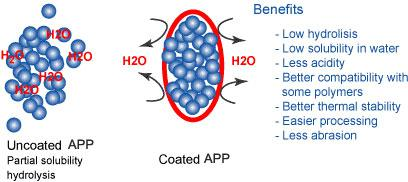
Note: APP Phase II has very low water solubility and is completely insoluble in organic solvents. Coated grades have even lower solubility.
4. CHEMICAL PROPERTIES AND REACTIONS
| Property | Description |
|---|---|
| Chemical Class | Inorganic polyphosphate |
| Unique Structure | Long-chain polymer with P-O-P linkages |
| Acid-Base Properties | pH 5.5 – 7.5 (10% suspension) |
| Chemical Stability | Stable, non-volatile compound |
| Thermal Stability | Phase II: decomposition starts ~300°C |
| Hygroscopicity | Phase II: Low |
| Combustibility | Non-flammable |
Incompatibilities
-
Strong oxidizing agents
-
Strong bases
-
Active metals
Chemical Reactions
-
Thermal Decomposition: APP decomposes to form phosphoric acid and ammonia under high temperatures (>300°C for Phase II).
-
Intumescent Reaction: Phosphoric acid reacts with carbon source (e.g., pentaerythritol) to form polyphosphoric acid esters, leading to char formation.
5. SPECIFICATIONS
Critical Parameters for Fire Retardant Paint Manufacturers
| Parameter | Desired Value |
|---|---|
| P₂O₅ | ≥ 70% (typical 69-72%) |
| Nitrogen | ≥ 12% (typical 14-15%) |
| Moisture | ≤ 0.25% |
| pH | 5.5 – 7.5 |
| Solubility | ≤ 0.5% |
| D50 | 10 – 20 µm |
| Degree of Polymerization | > 1000 |
| Phase Structure | APP II |
Typical Specifications (Phase II)
| Parameter | Specification |
|---|---|
| Appearance | White powder |
| P₂O₅ Content | ≥ 69% |
| Nitrogen Content | ≥ 14% |
| pH (10% suspension) | 5.5 – 7.5 |
| Moisture | ≤ 0.25% |
| Solubility in Water | ≤ 0.5% |
| Average Particle Size | ≤ 15 µm |
| Degree of Polymerization | > 1000 |
Packaging Options
| Packaging Type | Weight |
|---|---|
| Paper Bags | 25 kg |
| Jumbo Bags | 500 kg / 1000 kg |
| Custom Packaging | Available upon request |
6. APPLICATIONS AND INDUSTRIAL USES
6.1 Role in Intumescent Paint
In intumescent paint systems, APP functions as the acid source:
| Component | Function |
|---|---|
| APP | Acid Source |
| Pentaerythritol (PER) | Carbon Source |
| Melamine (MEL) | Blowing Gas Source |
During fire:
-
APP forms phosphoric acid.
-
Pentaerythritol carbonizes.
-
Melamine releases gas.
-
A thick swollen char layer is formed.
-
The steel surface is protected from heat.
6.2 Key Advantages
-
Halogen-free
-
Low smoke generation
-
Environmentally friendly
-
REACH compliant
-
Key component of intumescent systems
-
Compatible with PP, PE, PA, PU, Epoxy, and Polyester systems
6.3 Application Selection Guide
| Application | Recommendation |
|---|---|
| Interior Intumescent Paint | APP 201 |
| High Surface Quality | APP 201F |
| Thin Film Fire Paint | APP 201F |
| Exterior Fire Paint | APP 202 |
| Solvent-Based Systems | APP 202 / APP 203 |
| Epoxy Fire Paint | APP 205 |
| PP Compound | APP 204 |
| PE Compound | APP 204 |
| PA6 / PA66 | APP 203 |
| PU Foam | APP 201 / APP 203 |
7. BIOLOGICAL AND STRUCTURAL PROPERTIES
| Property | Description |
|---|---|
| Essentiality | Not applicable |
| Synthesis | Not applicable |
| Unique Structure | Not applicable |
| Protein Structure | Not applicable |
| Primary Function | Not applicable |
| Physiological Role | Not applicable |
Note: This product is an industrial flame retardant. It is not intended for biological, pharmaceutical, or food applications (except agricultural fertilizer use).
8. BIOCHEMICAL APPLICATIONS
| Application | Description |
|---|---|
| Cell Culture | Not applicable |
| Protein Research | Not applicable |
| Metabolomics | Not applicable |
| Microbiology | Not applicable |
Note: Not applicable for this industrial flame retardant.
9. SAFETY AND TOXICOLOGY
9.1 Acute Toxicity
| Parameter | Value |
|---|---|
| Oral LD₅₀ (rat) | > 5,000 mg/kg (ECHA) |
| Dermal LD₅₀ (rat) | > 5,000 mg/kg |
| Inhalation LC₅₀ | Not provided |
| Skin Irritation | Mild irritant |
| Eye Irritation | Causes serious eye irritation (H319) |
| Skin Sensitization | Not classified |
9.2 Chronic Toxicity
| Endpoint | Classification |
|---|---|
| Carcinogenicity | Not classified (no data available) |
| Mutagenicity | Not classified |
| Reproductive Toxicity | Not classified |
| Environmental Toxicity | Not classified as hazardous to aquatic environment |
9.3 GHS Classification
| Classification | Category | Hazard Statement |
|---|---|---|
| Acute Oral Toxicity | Acute Tox. 4 | H302 – Harmful if swallowed |
| Eye Irritation | Eye Irrit. 2 | H319 – Causes serious eye irritation |
| Signal Word | Warning | - |
| Pictograms | GHS07 (Exclamation mark) | - |
Note: Some SDSs classify APP as not a dangerous substance according to GHS. The harmonized classification from ECHA includes Acute Tox. 4 (H302) and Eye Irrit. 2 (H319).
9.4 Precautionary Statements
| Code | Statement |
|---|---|
| P264 | Wash hands thoroughly after handling. |
| P270 | Do not eat, drink or smoke when using this product. |
| P280 | Wear protective gloves/protective clothing/eye protection/face protection. |
| P301+P312 | IF SWALLOWED: Call a POISON CENTER or doctor if you feel unwell. |
| P305+P351+P338 | IF IN EYES: Rinse cautiously with water for several minutes. Remove contact lenses if present and easy to do. Continue rinsing. |
| P337+P313 | If eye irritation persists: Get medical advice/attention. |
| P501 | Dispose of contents/container to local/regional/national/international regulations. |
9.5 Safety Precautions and PPE
Hazards:
-
Harmful if swallowed
-
Causes serious eye irritation
-
May cause mild skin irritation
PPE (recommended):
-
Chemical-resistant gloves
-
Safety goggles
-
Suitable work clothing
-
Dust mask (if dust is generated)
9.6 Environmental Fate
| Parameter | Value |
|---|---|
| Biodegradability | Not applicable (inorganic substance) |
| Aquatic Toxicity | Practically non-toxic |
| Bioaccumulation | Not applicable |
| Ecotoxicity Classification | Not classified as hazardous to aquatic environment |
10. TRANSPORT INFORMATION
| Parameter | Information |
|---|---|
| UN Number | Not regulated |
| Proper Shipping Name | Ammonium Polyphosphate |
| Hazard Class | Not classified as dangerous goods |
| Packing Group | Not applicable |
| Marine Pollutant | No |
| ADR/RID | Not classified |
| IMDG | Not classified |
| IATA | Not classified |
| HS Code | 3824.99 |
Note: APP is not classified as dangerous goods for transport.
11. REGULATORY INFORMATION
| Region / Standard | Status |
|---|---|
| EU (REACH) | Registered (EC 269-789-9) |
| USA (TSCA) | Listed |
| Turkey (KKDİK) | Data not found |
| REACH Compliance | SVHC-free (some grades contain < 0.1% melamine) |
| Halogen-Free | Yes |
Note: APP is REACH registered and is SVHC-free according to Article 31 of the REACH Regulation (for grades with < 0.1% melamine).
12. STORAGE AND HANDLING
| Parameter | Information |
|---|---|
| Storage Conditions | Store in a cool, dry, well-ventilated area. Protect from moisture and direct sunlight. |
| Container Requirements | Keep containers tightly closed in a dry, cool place. |
| Materials to Avoid | Strong oxidizing agents, strong bases |
| Shelf Life | Data not found |
| Hygroscopicity | Low (Phase II) |
| Handling Notes | Avoid dust formation. Use appropriate PPE. |
| Packaging Options | 25 kg paper bags, 500 kg / 1000 kg jumbo bags |
13. FIREFIGHTING MEASURES
| Parameter | Information |
|---|---|
| Fire Hazard | Non-flammable |
| Extinguishing Media | Water spray, dry chemical, CO₂, foam |
| Special Hazards | Thermal decomposition may release nitrogen oxides (NOx), ammonia, and phosphorus oxides |
| Protective Equipment | Self-contained breathing apparatus (SCBA) and full protective clothing |
Note: APP is non-flammable but may decompose under fire conditions, releasing toxic fumes.
14. ACCIDENTAL RELEASE MEASURES
| Parameter | Information |
|---|---|
| Personal Protection | Use appropriate PPE (dust mask, safety goggles, protective clothing, gloves) |
| Ventilation | Ensure adequate ventilation |
| Control | Avoid dust generation; contain spill if safe to do so |
| Cleaning Methods | Use vacuum or careful sweeping to prevent dust; place in appropriate disposal container |
| Environmental Precautions | Prevent entry into drains, sewers, and water bodies |
| Waste Disposal | Dispose of according to local regulations |
15. FIRST AID MEASURES
| Exposure Route | Action to Take |
|---|---|
| Inhalation | Move person to fresh air. If breathing is difficult, give oxygen. Seek medical attention. |
| Skin Contact | Wash with plenty of soap and water. Seek medical attention if irritation persists. |
| Eye Contact | Rinse immediately with plenty of water for at least 15 minutes. Seek medical attention. |
| Ingestion | Rinse mouth with water. Do NOT induce vomiting. Drink plenty of water. Seek medical attention. |
16. RAW MATERIALS AND DOWNSTREAM PRODUCTS
16.1 Raw Materials (Upstream)
| Raw Material | Description |
|---|---|
| Phosphoric Acid | Main raw material |
| Ammonia | Main raw material |
16.2 Downstream Products
| Downstream Product | Application |
|---|---|
| Intumescent Coatings | Fire protection for steel structures |
| Flame Retardant Plastics | PP, PE, PA, PU compounds |
| Fertilizers | Agricultural phosphorus source |
| Water Treatment Chemicals | Scale inhibition |
17. SECTORAL SUITABILITY AND USAGE LEVELS
| Sector | Application Area | Example Use | Suitability |
|---|---|---|---|
| Construction | Intumescent fire protection | Steel structure fire paint | High |
| Plastics | Flame retardant compounds | PP, PE, PA, PU systems | High |
| Textiles | Flame retardant back-coating | Curtains, carpets, upholstery | High |
| Agriculture | Fertilizer | High-phosphorus fertilizer | High |
| Water Treatment | Scale inhibition | Industrial water systems | Moderate |
18. CARBON DIOXIDE ABSORPTION AND REAGENTS
Not applicable. APP is an industrial flame retardant and fertilizer and is not used for CO₂ absorption or as a chemical reagent.
19. DERIVATIVES AND RELATED COMPOUNDS
| Compound | Description | CAS Number |
|---|---|---|
| Melamine Polyphosphate (MPP) | Halogen-free flame retardant | 218768-84-4 |
| Ammonium Phosphate | Simple phosphate salt | 7783-28-0 |
| Red Phosphorus | Flame retardant | 7723-14-0 |
Note: APP is the primary acid source in intumescent systems, often used in combination with pentaerythritol (carbon source) and melamine (blowing agent).
20. SUMMARY AND CRITICAL WARNINGS
SUMMARY
Ammonium Polyphosphate (APP) is a halogen-free, phosphorus-based flame retardant. Under heat, it forms phosphoric acid, initiating the char formation mechanism and creating a protective barrier on the combustible surface. It is the key acid source in intumescent systems and is compatible with PP, PE, PA, PU, Epoxy, and Polyester systems.
It appears as a white powder (Phase II). Its P₂O₅ content is ≥69-72%, nitrogen content is ≥14%, pH is 5.5–7.5 (10% suspension), and degree of polymerization is >1000. It has very low water solubility (<0.1 g/100 mL) and is insoluble in organic solvents.
It is used in intumescent coatings for steel structures, flame retardant plastics (PP, PE, PA, PU), textile back-coatings, and as a high-phosphorus fertilizer.
Key Properties
| Property | Value |
|---|---|
| Appearance | White powder |
| Chemical Name | Polyphosphoric acids, ammonium salts |
| CAS Number | 68333-79-9 |
| EC Number | 269-789-9 |
| Molecular Formula | (NH₄PO₃)ₙ |
| P₂O₅ Content | ≥ 69-72% |
| Nitrogen Content | ≥ 14% |
| pH (10% suspension) | 5.5 – 7.5 |
| Water Solubility | Very low (<0.1 g/100 mL) |
| Degree of Polymerization | > 1000 |
| Phase Structure | APP II |
Main Application Areas
| Sector | Applications |
|---|---|
| Construction | Intumescent fire protection for steel structures |
| Plastics | Flame retardant PP, PE, PA, PU compounds |
| Textiles | Flame retardant back-coating |
| Agriculture | High-phosphorus fertilizer |
Key Safety Points
-
HARMFUL: Harmful if swallowed (H302).
-
EYE IRRITATION: Causes serious eye irritation (H319).
-
PPE REQUIRED: Use chemical-resistant gloves, safety goggles, and suitable work clothing. Use dust mask if dust is generated.
-
STORAGE: Store in a cool, dry, well-ventilated area. Keep containers tightly closed.
-
DISPOSAL: Dispose of according to local regulations.
Critical Warnings
-
APP is not classified as dangerous goods for transport.
-
Thermal decomposition may release nitrogen oxides, ammonia, and phosphorus oxides.
-
This TDS contains complete toxicological, transport, firefighting, and first aid data, but always refer to the supplier's official SDS/MSDS.
-
Do not use this TDS as a substitute for the official SDS/MSDS.
-
Users are responsible for determining the suitability of the product for their specific applications and for complying with all applicable regulations and safety requirements.
APP Equivalents Table
| Exflam | Clariant | Budenheim |
|---|---|---|
| APP 201 | Exolit AP 422 | FR Cros 484 |
| APP 201F | Exolit AP 423 | FR Cros 484 Fine |
| APP 1201 | Exolit AP 435 | FR Cros 584 |
| APP 202 | Exolit AP 462 | FR Cros C70 |
| APP 203 | Exolit AP 750 | FR Cros C30 |
| APP 204 | Variable equivalent | FR Cros 486 |
| APP 205 | Special grade | Variable equivalent |
One-Sentence Summary for Sales Team
-
APP 201: Economical and general-purpose fire paint grade.
-
APP 201F: Finer particle and smoother paint surface.
-
APP 1201: Low-viscosity premium paint grade.
-
APP 202: For exterior applications and systems requiring high moisture resistance.
-
APP 203: Improved plastic and resin compatibility grade.
-
APP 204: Silane-coated, ideal for PP/PE and cable compounds.
-
APP 205: Special grade for epoxy-based flame retardant coatings.
Disclaimer:
This Technical Data Sheet (TDS) is for informational purposes only. The information provided is based on the original technical summary, verified CAS/EC numbers, and data completed from reliable sources (ECHA, manufacturer SDSs, technical data sheets). However, the user is solely responsible for determining the suitability of the product for their specific applications and for complying with all applicable regulations and safety requirements. For complete safety, handling, storage, and regulatory compliance information, always refer to the official Safety Data Sheet (SDS/MSDS) provided by the manufacturer/supplier. Users are responsible for testing the product in their own processes and applications. All local, national, and international regulations must be followed when working with Ammonium Polyphosphate (APP).